


Discovering Analog’s Place in a Digital World
TL;DR
Explore the fascinating journey of Polaroid and discover the profound impact of multi-sensory experiences in photography and video gaming and beyond. Dive into the nostalgic and emotional connections that analog technology fosters in our digital age.
Journey to today
I’m familiar with the ebb and flow of business. Often ‘branding’ can be quite different from ‘entity’. Corporate fortunes rise (Weise, 2024), giants fall (The Economist, 2018), assets transfer (Hollywood Reporter, 2002) and ownership structures are constantly changing (Koch, 2014). That being said, I suppose because I seemed to recall various Polaroid branded products without apparent lapse, I hadn’t realized the Polaroid Corporation (Polaroid Corporation, 2024) I knew as a child ceased to exist in 2002.
Rather, I didn’t discover this fact until simultaneously learning of its rebirth. While searching for something to watch earlier this month, I came across ‘An Impossible Project’ (Kramer & Meurer, 2021) in my list of recommendations. Equal parts technology, business and history. Truly the algorithm has been honed.
The movie begins at the end, namely of the consumer photography industry. It’s a story that I’m confident you, assuming you are of a certain age, may already be familiar with. After years of decline and missed opportunities to expand outside of legacy photography, once worldwide leaders from America Kodak and Polaroid were at best shells of their former selves (Kodak Tries to Reinvent, 2020) and at worst ceased to exist in any meaningful way (Polaroid – Rise and Fall, 2021). I find these companies completely fascinating from a business perspective, that lack of reinvention resulted in unmitigated failure. Each had institutional knowledge that could have been parlayed into new products and/or markets. Chemicals, miniaturization, and ironically digital technologies. Even so, events and circumstances, both self-fulfilling and thrust upon them, conspired to dramatically decrease their reach.
The Sensory Experience
Yet, purely for the purpose of this writing and in recognition of the place their products filled in society, this line of thought misses the point. While diversification may have led to renewed life from a corporate perspective, it was their legacy creations that filled a special place in society for reasons that I had not previously contemplated. Enter ‘An Impossible Project’.
Photographs were at one time something more than just a picture to see. They have a tactile nature about them. Flipping through them, handing them amongst friends. There is an olfactory layer. You can smell them, the mustiness of an old family photo album, or the fresh photo paper just collected from the local photomat. Perhaps the slight chemical essence of that freshly ejected Polaroid? While capturing a particular moment in time, you simultaneously hear the click of the shutter while feeling the mechanical action of the camera trigger. In terms of an instant camera, this is further reinforced by the subsequent sound of the photograph ejecting. Knowingly or otherwise, there was sensory information being transmitted that is in full or part missing from today’s picture taking process.
Sense and Emotion
Just as importantly, senses impact emotion. These different facets work in tandem. “Our emotions and sensory cortices can impact one another in both directions.”. (Rago, 2014) Taking this a step further, “It is found that the conventional understanding of human sensory perception encompasses the five senses, which include visual, touch, auditory, olfaction, and taste. However, recent research increasingly suggests that humans possess an additional sensory perception: emotion”. (Chaniporn, et al., 2024)
Further, when more of our senses are working together, the stronger this emotional connection will be. It’s an idea that Dr. Florian Kaps, one of the Co-Founders of the modern incarnation of Polaroid, and others eloquently explore throughout the movie. He also expounds that today’s fully digital photography, and much of how we interact with our world overall, only touches upon 2 of our senses: visual and auditory. Touch, smell and taste are either relegated to a much-diminished state or removed altogether.
Emotion vs Nostalgia
I think this philosophy of Sense impacting Emotion can sometimes be mistakenly trivialized as nostalgia. To be sure, these ideas are certainly intertwined. Afterall, nostalgia is a very emotional-based concept. And it is created through multi-sensory stimuli coming together to create an emotional connection through our previous selves. However, it denotes a wistfulness for the past, often as much so for other personal associations with bygone eras than any one particular thing. It also may connotate, within a certain context, placement of an elevated or outsized importance based on those other personal associations.
Conversely, ‘An Impossible Project’ highlights the beneficial emotional connections that are creatable today based on analog technology able to incorporate more of our senses than its fully digital counterparts. It just so happens that this technology is one predominant from a past age that many of us may have nostalgia for.
Put another way, the bonds we create today may become the nostalgia of the future, creating those bonds is easier and more effective when rooted in a multi-sensory manner, and analog technologies were often more effective in doing so.
Further, one could debate that due to the fully digital nature in much of how we interact with our world today, we have lost a bit of the foundation upon which those attachments are created.
Analog Today
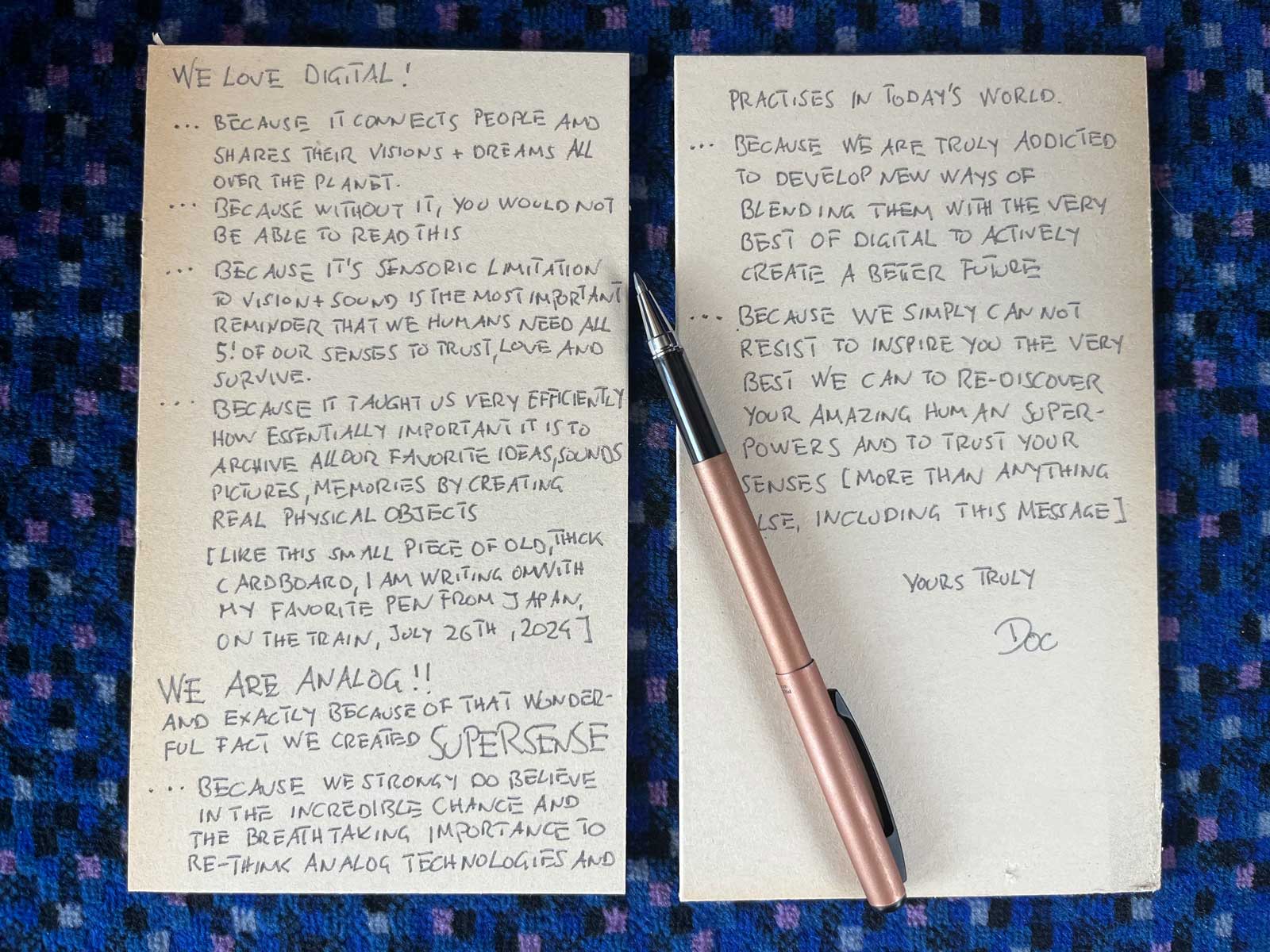
We Love Digital! WE ARE ANALOG!!
Florian Kaps
What I really appreciate from the movie, and even more so Dr. Kaps’ subsequent work with Supersense, is a recognition that modern digital technologies are wonderful for all of their strengths. “We Love Digital!” (Kaps, 2024). People the world over sharing visions and dreams. Archiving thoughts and ideas, the extent to which our species has never seen. According to some estimates, as of a decade ago we had already passed the point at which more photographs were taken in a single year than throughout all of human history, (Evans, 2015), while an estimated 1.96 trillion phots will be taken in 2026 (Wright, 2024).
Dr. Kaps continues however by emphatically stating “WE ARE ANALOG!!”. While in context this likely refers to Supersense’s mission, taken in conjunction with messaging from the ‘An Impossible Project’ movie, it just as aptly refers to Us.
Digital, over time, may have shone a light on the importance of those areas it is simply not positioned to fulfill.
I am not always proficient at taking a multi-faceted approach. But one of my takeaways from the movie was, why do I need to miss out on the benefits of analog? In relation to photography, I am in no way going to stop taking pictures on my iPhone. 99.9% of the pictures I take will be digital. However, did I want to continue missing out on this tiny little slice of sensory input? Perhaps this was just nostalgia for a simpler time. Then again, maybe it’s a bit more than that.
Analog in Video Gaming
A fair question at this time would be “why would I be expounding this topic as part of a blog ostensibly dealing with video games?”. It seems a bit oxymoronic. Intrinsically video games are digital, and by their nature remain pursuits apt only in rousing our visual and auditory senses. Regrettably this reasoning at once discounts the other senses, their place in creating emotional bonds to the things with which we interact and loses sight of the more esoteric areas of our hobby.
For some time, there has been debate within the video game community between ‘digital’ versus ‘physical’. More precisely between an all-digital distribution method for video games or a more tangible method whereby game code is provided on a physical medium such as cartridge or optical disc. As part of this dialogue issues of ownership, longevity and preservation are most prevalent.
There are a multitude of advantages and disadvantages with each. In my own personal pursuits, I am moving towards taking a more balanced approach to my gaming life, following a path that works within each situation and without feeling the need to prescribe an all-or-nothing policy.
Despite the above take on the topic, another perspective exists, and one that is more nuanced. Beyond ‘digital’ versus ‘physical’, I would propose a conversation on ‘digital’ versus ‘analog’. A discussion within our community regarding those aspects of video gaming that arise from the physical parts surrounding the artform and work to serve more of our senses, thereby creating stronger connections.
The feel of opening a disc box or of handling the game disc. The sound of opening a jewel case or hum of an optical drive coming to life. Even the scent of a game manual or your local video game store. This may, at face value, seem farcical. In truth, nothing more than the nostalgic call from a bygone era and longing for simpler times.
Recognition of Analog Across Fields
Our perceptual experience is fundamentally integrative
Saxena, Qamruddin, & Dubey, 2023
I no longer believe this notion can be distilled down to such a level of simplicity. Research indicates the importance of multi-modal sensory stimulation beginning at infancy. “The experience of touch, sounds, voices, smells and visual stimuli in daily contexts not only carries information about the surrounding environment per se, but is often matched with social and emotional meetings” (Carnevali, et al., 2024).
Given its importance starting at such an early age, there is a recognition across disciplines that multi-sensory input strengthens emotional ties. I did not believe, for example, the discipline of Architecture had given any thought towards how a building imprints upon the public beyond visualization. Yet a recent study outlines how each sense plays its part.
The study speaks to the notion of Attention, defined as a “pivotal pathway to healing ourselves and the world, as it is a sensory process that enhances mental health and promotes sustainable behavior”. While Attention and Emotion may not be completely synonymous, in the given context, I believe them to be interchangeable. While acknowledging visual perception’s crucial role in relation to Architecture and Attention, it continues that “Tactile perception strongly influences visual perception….”, while auditory cues are “crucial for creating atmosphere”. Olfactory sense is noted here for its “potential to preserve memories”. Even taste is called out, recognizing that while there may not be a direct correlation between Architecture and taste, “it can still stimulate and evoke taste perceptions”, with examples noted of warm tone usage to stimulate appetite as part of restaurants’ design. (Chaniporn, et al., 2024)
A study in the architecturally adjacent field of interior design too recognizes that while the visual sense may be most active, when paired with our other senses our experiences are more fully shaped. “Our perceptual experience is fundamentally integrative, binding together in a seamless way inputs from multiple sensory stimuli with motor plans and action executions. (Saxena, Qamruddin, & Dubey, 2023)
I believe there are parallels between these ideas and how they can be interpreted within the video game community. I would espouse that by embracing science and a more detailed understanding of underlying drivers impacting us to such an extent emotionally, we will be better able to appreciate and support their importance. Efforts should be made to cease trivializing these analog aspects of our shared passion as outdated or nostalgic and instead welcome their strengths and how they may fit into our modern gaming landscape.
The Future
I will refer to and expand upon the thoughts shared above in future blog posts. There are many people, companies and organizations that are performing brilliant work when it comes to the physicality, or analog aspects, of video games. This work will often center on topics of history, preservation and business. I can now appreciate however the opportunity afforded to me by ‘An Impossible Project’ to give thought to the emotional aspects of video gaming as made possible through analog means.
Works Cited
Ackerman, J. M., & Nocera, C. C. (2010, June 25). Incidental haptic sensations influence social judgments and decisions. Science, 328(5986), 1712-1715. doi:http://dx.doi.org/10.1126/science.1189993
Carnevali, L., Longa, L. D., Dragovic, D., & Farroni, T. (2024, March/April). Touch and look: The role of affective touch in . (G. Bremner, Ed.) Infancy, 271-283. doi:https://onlinelibrary.wiley.com/doi/10.1111/infa.12580
Chaniporn, T., Meksrisawat, P., Jinjantarawong, N., Sinnugool, S., Phaibulputhipong, P., Chunhajinda, P., & Bhutdhakomut, B. (2024, July 25). A Systematic Review of Architecture Stimulating Attention. Sustainability, 16(15). doi:https://doi.org/10.3390/su16156371
Daniels, T. (2024, January 2). Photography Statistics & Trends (2024). Retrieved December 14, 2024, from Lapse of the Shutter: https://www.lapseoftheshutter.com/photography-statistics/
Ernst, M. O., & Banks, M. S. (2002, January 24). Humans integrate visual and haptic information in a statistically optimal fashion. Nature, 415(6870), 429-433. doi:http://dx.doi.org/10.1038/415429a
Evans, M. (2015, September 1). More Photographs taken in one year than in the entire history of film. Retrieved December 14, 2024, from MACFILOS: https://www.macfilos.com/2015/09/01/2015-9-1-more-photographs-taken-in-one-year-than-in-the-entire-history-of-film/
Grujin, J. (2023, June 28). How Many Pictures? Photo Statistics That Will Blow You Away. Retrieved December 14, 2024, from Light Stalking: https://www.lightstalking.com/photo-statistics/
Holden, J. (2006, June 21). Just follow your nose. Nursing Standard, 20(41), 30-31. Retrieved December 12, 2024
Hollywood Reporter. (2002, September 25). Microsoft game for Rare. Hollywood Reporter, 375(18), p. 10. Retrieved December 12, 2024, from link.gale.com/apps/doc/A92458245/GBIB?u=nysl_ce_ocpl&sid=bookmark-GBIB&xid=6d3a7aae.
How Polaroid Went From Celebrity Favorite To Bankruptcy | Rise And Fall (2021). [Motion Picture]. United States of America: YouTube. Retrieved December 12, 2024, from https://www.youtube.com/watch?v=p07Zw_UklWk
Kaps, F. (2024, December 12). Supersense – Philosphy. Retrieved December 12, 2024, from https://impossible.supersense.com/: https://impossible.supersense.com/philosophy
Koch, W. (2014, October 6). Hewlett-Packard plans split. USA Today, p. 01A. Retrieved December 12, 2024, from link.gale.com/apps/doc/A384686000/AONE?u=ocpl_central&sid=bookmark-AONE&xid=9b021e4a.
Kodak Tries to Reinvent After Struggling to Adapt (2020). [Motion Picture]. United States of America: YouTube. Retrieved December 12, 2024, from https://www.youtube.com/watch?v=c7nLL81y9so
Kramer, F., Meurer, J. (Writers), & Meurer, J. (Director). (2021). An Impossible Project [Motion Picture]. United States of America. Retrieved from https://www.imdb.com/title/tt6477262/?ref_=vp_vi_tt
Lenehan, K. (2015, Winter). The Human Being as a Unity in Aesthetic Perception and Its Possible Meaning for Aesthetic Education in the Global Age. Journal of Aesthetic Education, 49(4), 55-70. Retrieved December 12, 2024
Polaroid Corporation. (2024, July 21). Retrieved December 12, 2024, from Wikipedia: https://en.wikipedia.org/wiki/Polaroid_Corporation
Rago, R. (2014, October 9). Emotion and Our Senses. Retrieved December 13, 2024, from EBBL, Tufts University: https://sites.tufts.edu/emotiononthebrain/2014/10/09/emotion-and-our-senses/
Saxena, A., Qamruddin, J., & Dubey, K. K. (2023, May). The Tactile Sensory Experience in Interior Design: Exploring the Impact of Touch on Emotional Responses. International Journal for Research in Applied Science & Engineering Technology, 11(V).
The Economist. (2018, November 12). Tears for Sears: American Retail. The Economist, 429(9114), 1. Retrieved December 12, 2024, from link.gale.com/apps/doc/A558719971/GBIB?u=nysl_ce_ocpl&sid=bookmark-GBIB&xid=a70a7de3.
Vuilleumier, P. (2005, December). How brains beware: neural mechanisms of emotional attention. Trends in Cognitive Sciences, 9(12), 585-594. doi:https://doi.org/10.1016/j.tics.2005.10.011
Walsh, C. (2020, February 27). What the nose knows. The Harvard Gazette.
Weise, K. (2024, May 1). For Amazon, First Quarter of Year Sees Record Profit. The New York Times, B3. doi:link.gale.com/apps/doc/A792154993/GBIB?u=nysl_ce_ocpl&sid=bookmark-GBIB&xid=6f722b78
Why Fujifilm Survived (& Kodak Didn’t) (2023). [Motion Picture]. YouTube. Retrieved December 12, 2024, from https://www.youtube.com/watch?v=AdDIy0c5ZGo
Wright, D. (2024, July 12). Photography Industry Statistics: Key Facts and Trends. Retrieved December 14, 2024, from Great Big Photography World: https://greatbigphotographyworld.com/photography-statistics/



Leave a Reply